For drivers
How to start competing in Assetto Corsa drifting
Going from casual drifting to a judged competition is mostly about preparation. This is the path from your first setup to your first event.
Key takeaway
Get a wheel and Content Manager, practice a judged line until it is consistent, then apply and prepare your car early.
Step 1: Get the right setup
- Assetto Corsa on PC. Competitions run on the PC version.
- Content Manager. The community launcher most competitions require for installing cars and tracks, joining servers and running checks.
- A wheel and pedals. Organized competitions generally require them; you don't need a high-end direct drive wheel to start.
- A stable PC and connection. Lag and disconnects are a common cause of lost runs.
- Discord. Almost every competition uses it for applications, briefings and live calls.
| You need | Why |
|---|---|
| Assetto Corsa (PC) | Competitions run on the PC version. |
| Content Manager | Installs cars and tracks, joins servers and runs checks. |
| Wheel and pedals | Generally required for organized competition. |
| Stable PC and internet | Lag and disconnects cost runs. |
| Discord | Applications, briefings and live calls. |
For EFVD, the supported setup is Windows 10 or 11, or a qualified Ubuntu x64 setup with Steam, Proton, Assetto Corsa and Content Manager. See EFVD's requirements.
Step 2: Learn to drive to a judged line
Casual drifting and competition drifting are different skills. In competition you have to put the car in specific places, consistently, under pressure.
- Practice on competition-style courses with marked zones and clips, not just open lots.
- Work on consistency: five clean, similar runs beat one spectacular one.
- Practice transitions and holding steady angle; straightening and corrections are expensive.
- Practice tandem on public servers: following someone closely is its own skill.
- Learn how runs are judged. Read our judging guide.
Step 3: Use competition-legal car physics
Competitions standardize car physics so results come down to driving, not car files. Many use a shared physics set; EFVD uses an approved suite based on VDC data and publishes an official Car Tech Kit. Practice with the physics you'll compete with, so the car feels the same on event day.
Step 4: Choose a competition and apply
Look for a competition with published rules, a clear judging guide, a regular schedule and a format that suits your level. Most take applications through Discord.
For example, to join EFVD you open the #driver-application channel in its Discord and press Apply to Compete. Staff review each application; once accepted, you use My EFVD for your driver profile and to request individual rounds. A team, sponsor or past results are optional. See the applicant guide.
Step 5: Prepare and submit your car
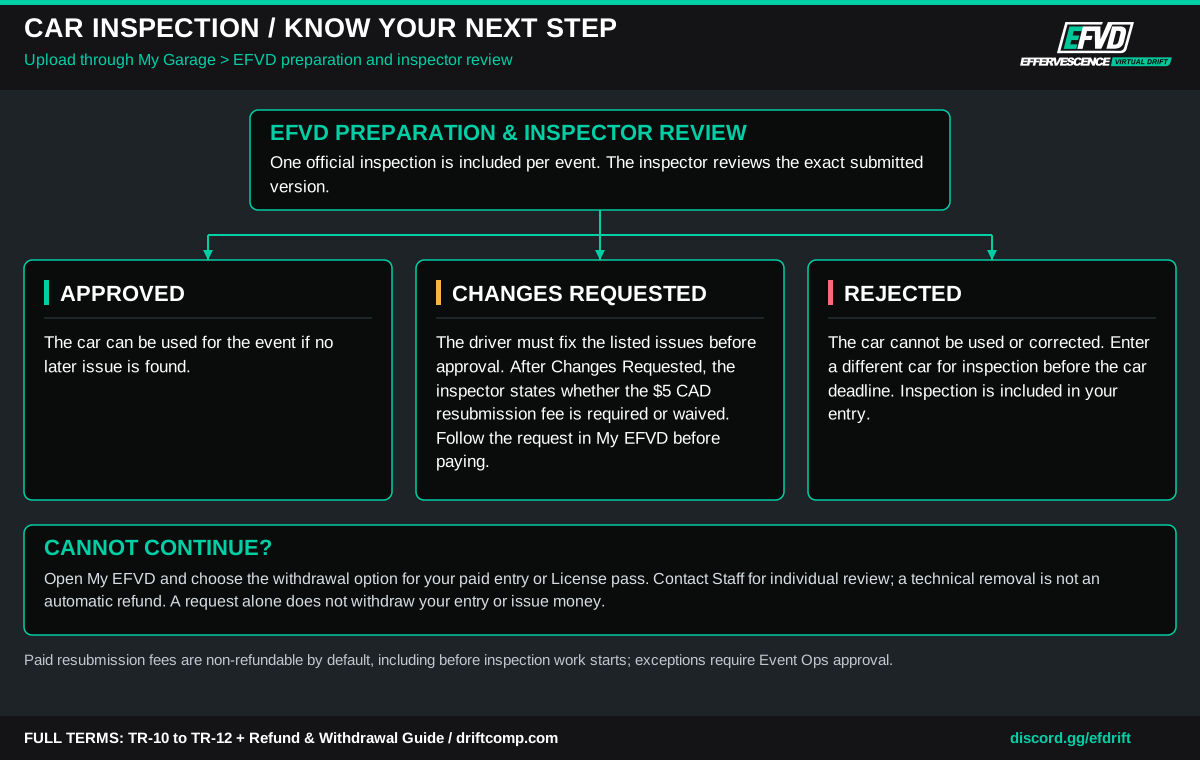
Most competitions inspect cars before an event. Expect checks on physics, file structure, optimization (triangles, textures and file sizes) and livery. Submit early so you have time to fix anything the inspectors flag. EFVD's Technical Regulations and its car preparation checklist show what a typical inspection covers.
Inspections usually end in one of three outcomes. This is how EFVD handles them:
Step 6: Get ready for event day
- Read the event briefing and know the course, zones and start procedure.
- Install the official track and join practice early to confirm you can reach the server.
- Test your wheel, pedals, audio and connection before the event.
- Be available for the whole schedule, from the driver briefing onward.
Step 7: Compete
- Briefing: listen for course and procedure details.
- Qualifying: drive your solo runs when your group is called. Your best valid score counts.
- Battles: if you qualify, run lead and chase against your opponent.
- Accept the call: judges' decisions are final during the event; ask questions afterwards through the proper process.
Common first-event mistakes
| Mistake | How to avoid it |
|---|---|
| Not reading the rules | Read the competition, judging and technical guides before applying. |
| Broken car files | Submit clean, correctly named files before the deadline. |
| Missing the briefing | Be on time; event-specific instructions are given there. |
| Driving during official sessions | Only go on track when you are called. |
| Arguing with judges live | Accept the call and use the clarification process after the event. |
| Not showing up without a message | Tell staff as soon as you know you can't attend. |
Frequently asked questions
- Do I need a direct drive wheel to compete?
- No. You need a wheel and pedals; many competitive drivers start on entry-level wheels. Consistency matters more than hardware.
- Do I need a team or sponsor to apply?
- Usually not. For EFVD, team, sponsor and previous results are optional; you describe your drift experience and answer the required questions.
- How do I know if my car is legal?
- Read the competition's technical rules and use its approved physics. Competitions inspect cars before the event and tell you what to fix.
- How good do I need to be before entering?
- You should be able to drive the judged line consistently without spinning or straightening. Qualifying sets the bracket, so you can enter, learn and improve round by round.
Your next step
Compete or organize
For drivers
Compete with EFVD
Judged qualifying and tandem battles in an international Assetto Corsa drift championship.
Compete at driftcomp.com →For organizers
Organize with Event Toolkit
Judging, broadcast, registration and Discord tools built from the ones that run EFVD.
Organize at drifttournamentapp.com →